

High temperatures pose unique challenges for labeling, from ink fading and adhesive failure to
legibility and regulatory compliance. At Label-Aid Systems Inc, we understand that reliable
performance under heat is essential for safety, efficiency, and traceability in industries ranging from
manufacturing to aerospace.
This guide dives into the key considerations for high temperature labels, including substrate selection, adhesive compatibility, print methods, and durability testing, so you can choose labels you can trust in demanding thermal environments. Whether you’re protecting equipment, ensuring compliant documentation, or safeguarding product integrity, our practical insights help you navigate the options and make informed decisions.
Precision Labels. Proven Performance. Trusted Since 1976.
Label-Aid Systems is an ISO 9001:2015 certified manufacturer delivering high-quality labels, decals,
and graphic overlays engineered for durability and accuracy. For over five decades, our experienced
team has partnered with companies across diverse industries to provide precision printing, cutting,
and assembly solutions that perform in the real world.
Using advanced screen, digital, and flexographic technologies, we produce:
From concept to completion, we focus on reliability, consistency, and craftsmanship, ensuring every
product meets the highest standards of performance and quality.
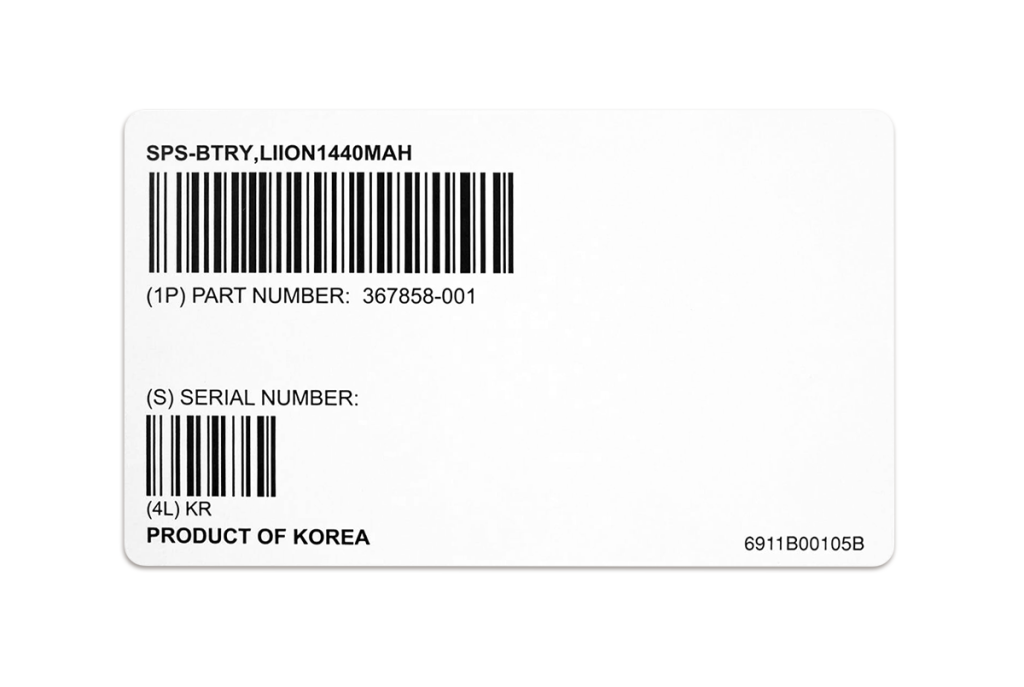
When your product or equipment is exposed to moderate heat, selecting the right label material is critical for durability, performance, and long-term readability. Polyester films (PET – polyethylene terephthalate) are the ideal solution for temperatures up to 302°F (150°C), offering exceptional thermal stability while maintaining strength, clarity, and print quality.
Unlike many label materials that degrade or lose dimensional stability under heat, polyester labels retain their physical and mechanical properties even during continuous service in elevated temperatures. This makes them a reliable and cost-effective alternative to high-temperature specialty materials.
Our custom polyester labels also support full-color printing without fading, smearing, or ink breakdown at elevated temperatures, ensuring your branding and critical information remain legible and professional.
If your application operates at 302°F or lower, polyester film labels provide the most logical and economical labeling solution.
Key Features & Advantages of Polyester (PET) Labels
Material Options & Finishes for Polyester Labels (PET):
For added protection and enhanced durability, optically clear overlaminates are offered in both gloss and matte finishes.
Polyester films are practically impermeable to moisture and odors, making them ideal for demanding industrial and outdoor environments. Our Mylar® polyester labels perform exceptionally well in applications exposed to weather, UV light, and harsh conditions.
Ideal Applications – Polyester labels are commonly used for:
Need heat-resistant custom labels?
Contact us to design custom polyester labels engineered for moderate heat, durability, clarity, and long-term performance.
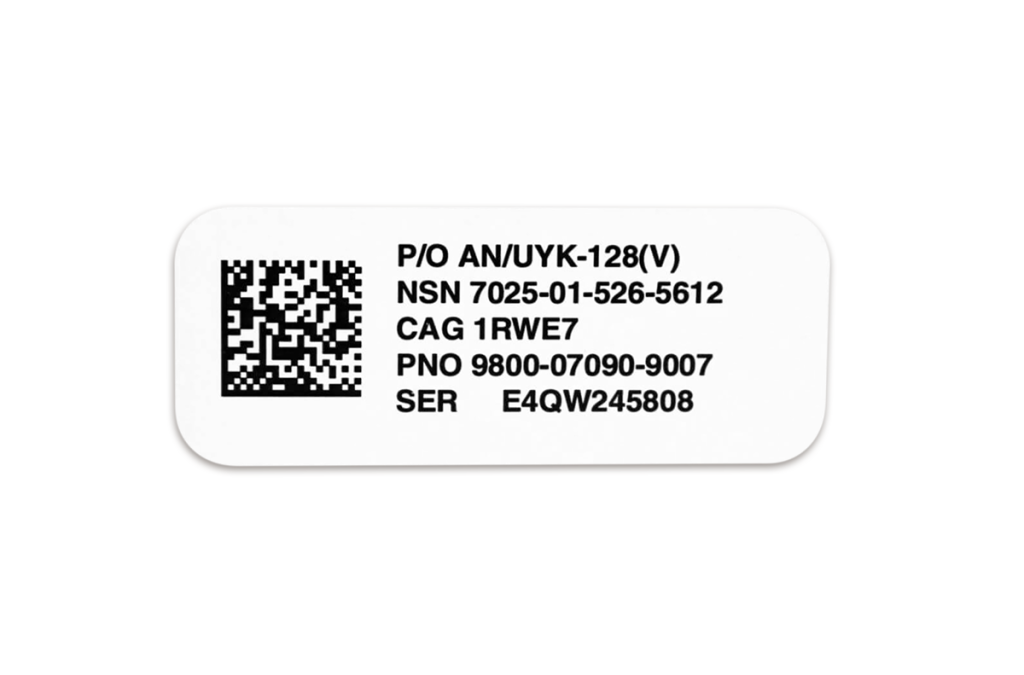
In high-heat manufacturing environments, standard labels simply do not survive. When exposed to sustained temperatures above 302°F (150°C), conventional paper, polyester, and acrylic adhesive labels quickly fail — melting, curling, fading, or detaching entirely.
For operations that rely on accurate product identification, barcode scanning, traceability, and regulatory compliance, label failure is not just inconvenient — it can shut down production.
High temperature labels engineered for extreme heat environments are essential for maintaining asset tracking, work-in-process visibility, and part identification throughout demanding thermal processes.
At Label-Aid Systems Inc, we design and manufacture custom high heat label solutions specifically for industrial applications where durability, adhesion, and legibility must be maintained through ovens, curing lines, soldering, heat treating, and other elevated temperature processes.
Why Standard Labels Fail in High Heat Environments
Typical labels made with paper facestocks, conventional films, and acrylic adhesives begin to degrade far below industrial processing temperatures. When exposed to heat, they may:
For manufacturers, this leads to:
When labeling must survive continuous or intermittent heat exposure, only purpose-built heat-resistant labeling materials should be used.
Engineered High Temperature Labels for Extreme Conditions
Our custom high temperature labels above 302°F are manufactured using specialized facestocks and high-performance adhesives designed to:
These labels are ideal for in-process identification, asset tracking, serialized labeling, and compliance marking where durability is non-negotiable.
Critical Printing Considerations Above 302°F
For applications exceeding 302°F, there is an important technical limitation: Conventional inks cannot survive these temperatures. Multi-color or ink-based printing will degrade, discolor, or disappear entirely.
Instead, we utilize:
This process ensures:
This method provides the most reliable solution for heat resistant barcode labels and industrial tracking systems.
Industries That Require High Temperature Labeling Solutions – Our heat-resistant labels are trusted across demanding industrial sectors, including:
Why Temperature Resistance Matters for Production Efficiency
Consider a heat-treating oven operating at 400°F (204°C). A standard label may fail before the part exits the process — eliminating traceability at the exact moment it’s needed most.
A properly engineered high temperature industrial label, however, remains:
This reliability directly supports:
Custom High Heat Label Solutions from Label-Aid Systems Inc
Every high-temperature application is different. Substrate type, dwell time, peak temperature, and environmental exposure all impact label performance.
We work directly with engineers and production teams to develop:
If your process exceeds 302°F, don’t risk downtime with standard labels. Specify a high temperature labeling system designed for your environment.
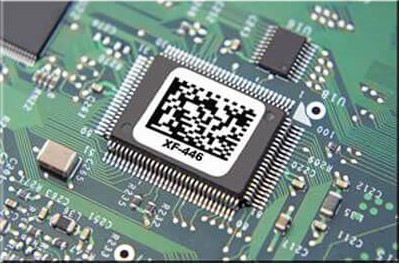
Engineered Polyimide & Polyester Labels for Extreme Electronics Processes
Our high-temperature polyimide labels are purpose-built for electronics assembly, PCB fabrication, and SMT manufacturing environments where conventional labels fail. Designed for thermal transfer printing, these labels deliver durable, scannable barcodes, QR codes, serial numbers, and sequential traceability data that remain readable through reflow, wave solder, cleaning, and handling.
Ideal for:
Harsh Flux & Abrasion Resistant Polyimide Labels – Built for High Heat, Chemicals, and Mechanical Stress
Our flux-resistant PCB labels are engineered to maintain adhesion and legibility through the most aggressive manufacturing conditions, including ORH1 flux exposure, high-pressure wash cycles, and elevated temperatures.
Key Features:
Best for: traceability labels, process routing labels, and permanent PCB identification.
ESD-Safe Polyimide & Polyester Labels – Static Dissipative Labels for Sensitive Electronics
Protect sensitive components with ESD-compliant labels designed to minimize electrostatic discharge during handling and assembly. These static dissipative materials reduce charge generation and protect boards, chips, and devices from damage.
Key Features:
Standards Compliance:
Best for: semiconductor, PCB assembly, and sensitive electronic device labeling.
Flame Retardant & Safety-Certified Labels – Fire-Safe Labels for Regulated Industries
Our flame retardant labels help reduce fire propagation risks while maintaining performance under heat and stress. These labels meet critical UL, aerospace, and automotive flammability standards, making them suitable for highly regulated applications.
Key Features:
Certifications & Testing:
Best for: aerospace electronics, automotive modules, power systems, and safety-critical devices.
Why Engineers Choose Our Electronics Labels
If you need reliable, high-performance labels that survive your entire manufacturing process, our materials are validated for real-world electronics environments.
Our high-temperature thermal transfer labels and tags are engineered specifically for steel mills, aluminum plants, and metals processing environments where conventional labeling systems fail. Designed to withstand continuous and peak heat exposure, these labels maintain barcode integrity and adhesion throughout casting, rolling, storage, and transport operations.
Built for direct application to billets, slabs, coils, ingots, plates, and sows, these labels enable reliable part identification and end-to-end traceability across your production workflow—from hot processing through finished goods handling.
Engineered for Extreme Heat Environments
With heat resistance up to 1112°F (600°C), our labels remain readable and securely bonded during high-temperature manufacturing stages. Thermal transfer print compatibility ensures crisp, durable barcodes and variable data that scan accurately throughout your MES, WMS, or ERP systems.
Key Features
Operational Benefits for Metals Facilities
Typical Applications
If you need dependable labeling that survives high heat, heavy handling, and outdoor exposure, these labels provide the durability and data integrity required for modern metals manufacturing environments.
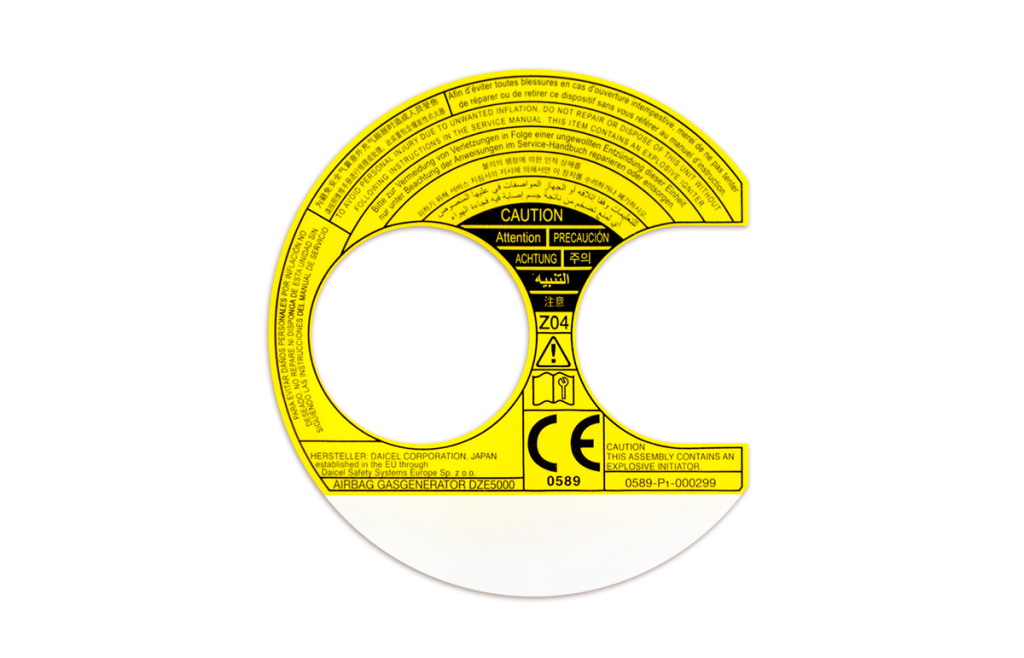
Automotive manufacturers require identification solutions that maintain adhesion, legibility, and material integrity throughout the full-service life of the vehicle. Under-the-hood and interior environments expose labels to sustained high temperatures, fluids, oils, abrasion, and aggressive chemicals, making material and adhesive performance critical.
Our high-temperature labels and tags are engineered for long-term durability and reliable adhesion across challenging substrates, including oily, low-surface-energy, smooth, and textured surfaces. Available constructions include PET, polyimide (PI), and ultra-high-temperature aluminum (AL), supporting a wide range of thermal and chemical exposure profiles.
Designed for thermal transfer printing and laser ablation, these labels deliver consistent print permanence and resistance to fade, smear, or degradation in demanding automotive environments.
Key Features & Specifications
These solutions support traceability, regulatory compliance, and lifecycle durability across engine compartments, powertrain assemblies, electronics, and vehicle interiors.
We offer a family of 5 mil (127µm) durable cryogenic label materials, specifically designed for laboratory use.
Laboratory, Medical, and Cryogenic Label Materials
Our high-performance nylon label materials are available in two grades with pressure-sensitive adhesives (PSA), engineered to conform effortlessly to small radii and curved surfaces. The unique woven nylon construction ensures secure adhesion and long-lasting readability, even on challenging applications.
Designed for demanding environments, these labels deliver outstanding resistance to harsh chemicals such as sodium hydroxide and mineral spirits. Independently tested and approved, they perform reliably on glass tubes, slides, and polypropylene tubes and vials, maintaining integrity for up to one hour of liquid nitrogen exposure at temperatures down to −320 °F (−196 °C). The durable surface supports thermal transfer and dot-matrix printing and can also be easily written on by hand with pens or markers.
Benefits:
Applications:
Medical Device Label Materials
We offer materials for the identification and tracking of medical devices that comply with the UDI initiative (tested to the UL/IEC 60601-1 and UL/IEC 61010-1 for coating durability).
The REACH and RoHS compliant materials include polyimide (PI) and polyester (PET) films (renowned for dimensional stability and chemical resistance in high temperature, harsh environment tracking applications) and high temperature PSAs.
Features and Benefits:
Applications:
Flame-Retardant Tedlar Alternative with Low Outgassing
We offer a high-performance polyimide label material engineered as a reliable, cost-effective alternative to Tedlar for aerospace manufacturers. Designed specifically for demanding environments, our flame-retardant solution performs exceptionally well in avionics, aerospace, and military applications.
By combining advanced coatings and halogen-free flame-retardant technologies with the inherent high-temperature resistance of polyimide film, we deliver a durable labeling solution that meets the rigorous requirements of the aerospace industry, including:
• FAR 25.853 and 25.855
• Smoke and toxicity testing per BSS 7238 and BSS 7239
• Halogen-free compliance (IEC 61249-2-21)
• REACH and RoHS compliant
• UL 969 (File MH 19503 PGJI2) and UL 94 V-0 rated
We also offer a range of materials that fully comply with NASA ASTM E595 low outgassing standards, achieving industry-leading performance in TML, CVCM, and WVR measurements.
To properly specify a high-temperature label rated above 302°F (150°C), you need to define several technical, environmental, and regulatory requirements.
1) Temperature Requirements (most critical)
Why: adhesives and films fail differently under cycling vs steady heat.
2) Exposure Duration
Why: some materials survive 500°F briefly but not long-term.
3) Surface (Substrate)
Why: adhesive selection depends heavily on this.
4) Chemical / Environmental Exposure
Will it contact:
Why: affects material & adhesive choice.
10) Compliance / Standards (if applicable)
Why: may affect material/adhesive choice.
__________________________________________________________________________________
In demanding environments, labeling isn’t just about identification—it’s about reliability. High-temperature labels from Label-Aid Systems are engineered to remain readable and secure where standard labels fail, helping protect your products, your processes, and your reputation.
If you’re facing harsh heat, chemicals, or abrasion, reach out to Label-Aid Systems to discuss a custom high-temperature labeling solution designed around your exact application.