

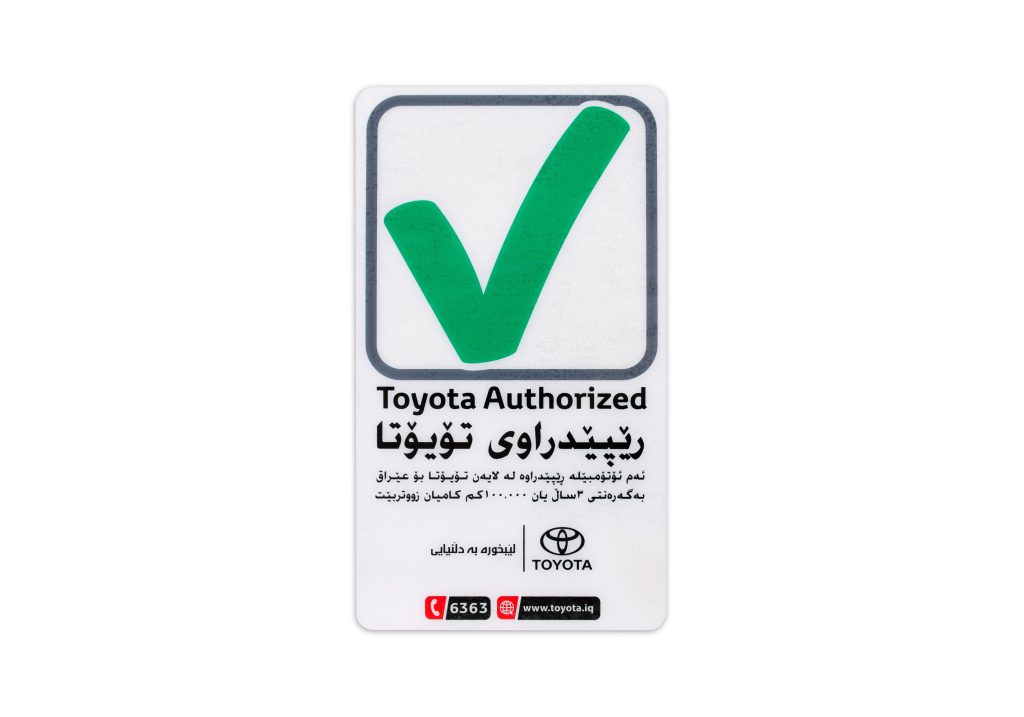
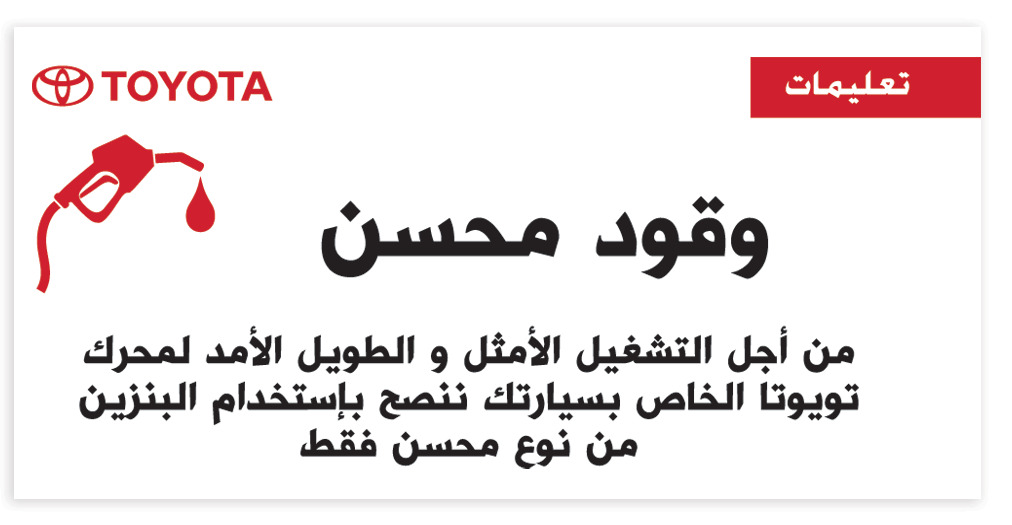
Label-Aid Systems, an ISO 9001 certified manufacturer of labels, graphic overlays, and decals has been manufacturing automotive labels since its beginning in 1976. We started with a local Chrysler electronics plant, and now serve automotive makers worldwide. Whether it’s a Nissan UL label that goes on a battery, an air bag actuator safety label, or labels for Toyota that that provide caution or instructions in Iraq, Label-Aid Systems has the know-how and the systems to serve the automotive industry.
In the automotive industry, labels go beyond mere identification tools, ensuring regulatory compliance, supply chain traceability, as well as communicating safety information. DURABILITY matters!
For technical buyers in original equipment manufacturing (OEM) and tier supplier organizations, selecting the right labeling solutions requires a comprehensive understanding of industry standards, material science, and adhesive technologies. This guide provides an in-depth analysis of automotive labeling requirements, technologies, and selection criteria to help procurement, supplier development personnel, and engineering teams make informed decisions that balance compliance, durability, cost-effectiveness, and operational efficiency.
The automotive industry operates under some of the most stringent labeling requirements across all manufacturing sectors. Labels must withstand extreme environmental conditions, maintain legibility throughout the vehicle lifecycle, comply with multiple regulatory frameworks, and increasingly support digital tracking and authentication systems.
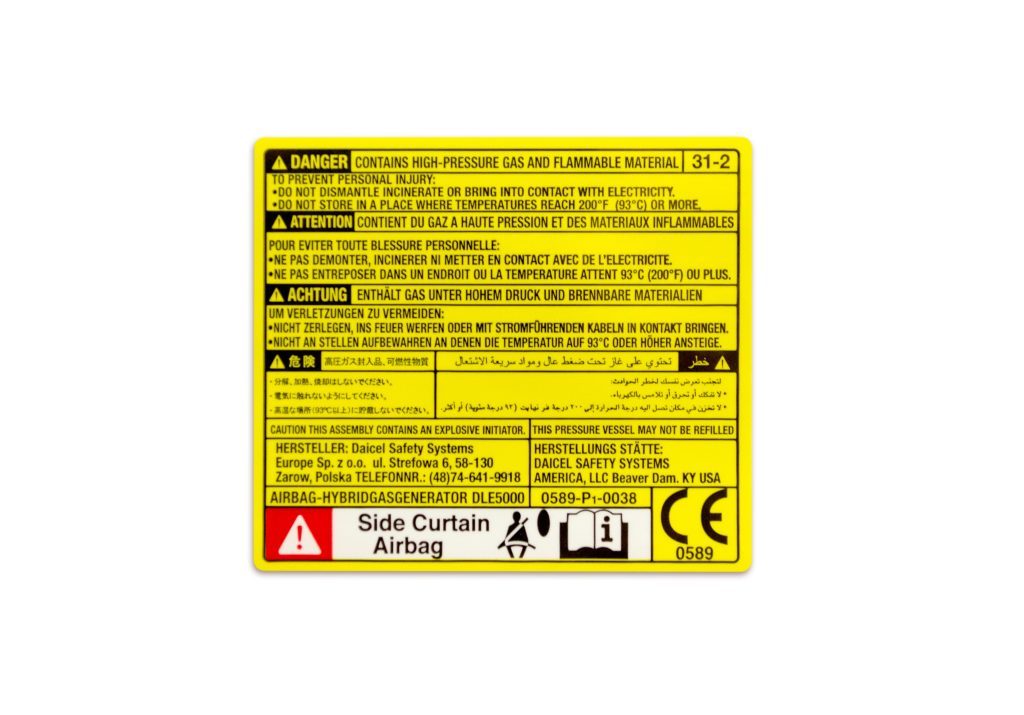
Safety & Warning Labels must communicate hazard information to technicians, service individuals, as well as end users. Examples include battery warning labels, airbag deployment safety labels, high voltage warning labels for electric vehicles, and supplemental restraint system (SRS) labels. Specific colors, symbols, and durability requirements are outlined in the Federal Motor Vehicle Standards (FMVSS) and international equivalents.
Regulatory & Compliance Labels
Regulatory and compliance labels are mission-critical components for ensuring vehicles meet applicable federal, state, and international standards across their lifecycle. The certification label—commonly referred to as the doorjamb label—provides key data points including Gross Vehicle Weight Rating (GVWR), date of manufacture, and OEM compliance certifications. Additional regulatory labels support system-level compliance by communicating emissions data, tire pressure specifications (TPMS), and HVAC refrigerant identification. For buyers in the automotive industry, these labels must be engineered for durability (lifetime of the vehicle), legibility, and long-term adhesion to meet evolving regulatory requirements and environmental exposure conditions.
Process and Assembly Labels
Process and assembly labels play a critical role in automotive manufacturing by enabling real-time traceability, error-proofing, and production efficiency. These labels support barcode and 2D data matrix scanning for work-in-process (WIP) tracking, ensure accurate component matching for quality control, and communicate assembly instructions at the point of use. In many applications, labels also provide temporary surface protection during fabrication and handling. For automotive buyers, it is essential to distinguish between labels designed for short-term use and those that must transition into permanent identification—requiring careful consideration of material selection, adhesive performance, and durability across downstream processes.
Service and Maintenance Labels
Service and maintenance labels deliver critical technical data required for accurate vehicle servicing and lifecycle support. These labels communicate key specifications to technicians, including fluid types and capacities, torque requirements, and recommended service intervals. For automotive buyers, service labels must be engineered for long-term legibility and resistance to chemicals, abrasion, and environmental exposure, ensuring that essential information remains accessible and compliant throughout the vehicle’s operational life.
Why Automotive Labels Require Specialized Materials
Automotive manufacturing environments are far more demanding than typical commercial labeling applications.
Standard paper or general-purpose labels, with standard adhesives will:
Automotive labels must withstand:
Only engineered films, specialty adhesives, and durable print technologies can meet these conditions.
Polyester (PET) is the dominant substrate for automotive labeling applications, offering an optimal balance of mechanical, thermal, and chemical performance for demanding environments. PET films maintain excellent dimensional stability across a wide operating range of -40°F to 302°F (-40°C to 150°C), while delivering high tensile strength and superior resistance to automotive fluids such as gasoline, diesel, brake fluid, and engine coolants. In addition, polyester provides strong UV and weathering resistance, making it well-suited for both interior and exterior labeling requirements.
From a specification standpoint, automotive-grade polyester is typically supplied in thicknesses ranging from 1.0 to 4.0 mils (25 to 100 microns), with 2.0 mil considered the standard for most OEM and Tier applications. Low moisture absorption supports consistent dimensional stability and long-term print fidelity, which is critical for legibility, barcode readability and regulatory compliance for the life of the vehicle.
Polyester substrates are compatible with multiple print technologies, including thermal transfer, laser marking, flexographic, digital and screen printing. Polyester films (PET), is our most used material for most automotive applications. PET film is unmatched in its versatility.
Vinyl (PVC) films are widely specified for automotive labeling applications that require high conformability across complex geometries and textured substrates. Their inherent flexibility makes them ideal for exterior graphics, contoured components, and applications where the label must stretch and adapt during installation. For technical buyers, vinyl is often the material of choice when surface irregularities would compromise adhesion or appearance with more rigid film constructions.
A key performance advantage of vinyl substrates is their high elongation capability, with certain formulations exceeding 200% elongation before failure. This enables reliable application over rivets, stamped features, and uneven surfaces without lifting, bridging, or wrinkling—critical for maintaining adhesion and visual integrity in demanding environments.
However, vinyl materials present limitations in high-temperature environments. Most automotive-grade vinyls are rated for continuous exposure up to approximately 180°F (82°C), with short-term peaks up to 212°F (100°C). As a result, their use is typically restricted to interior, or low-heat zones, while higher-temperature applications—such as engine compartments or exhaust-adjacent areas—require polyester or other high-performance substrates.
Polycarbonate and Specialty Films
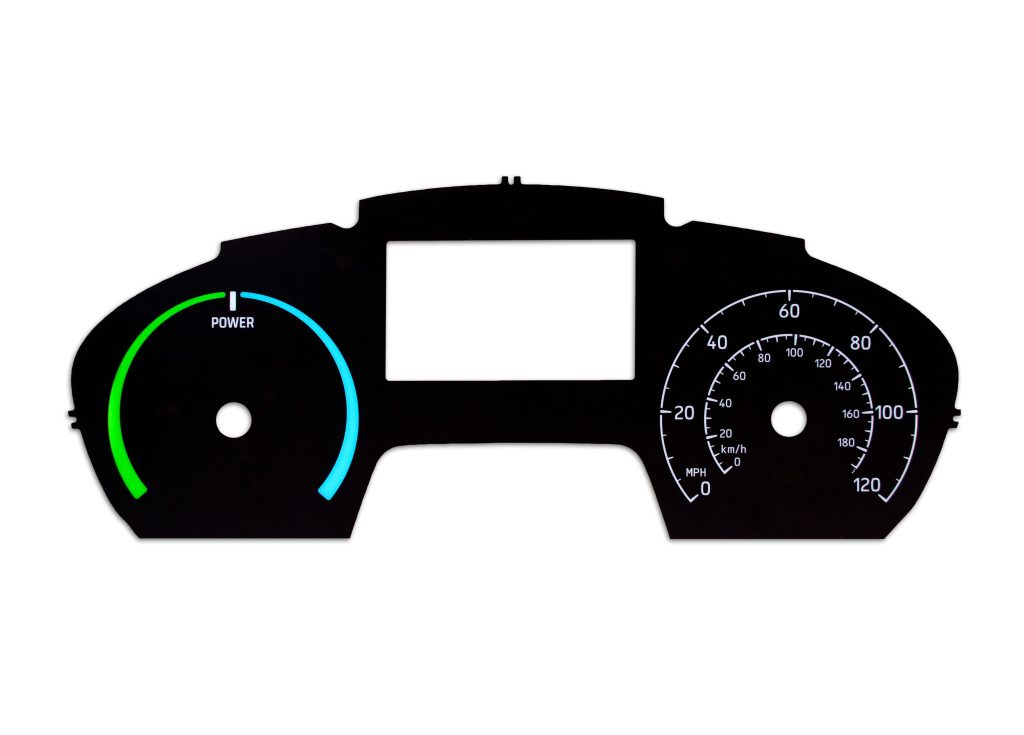
Polycarbonate (PC) films are engineered for automotive applications requiring high impact resistance, durability, and optical clarity. These materials are commonly specified for overlays on display interfaces, control panels, and instrument clusters, where they must withstand repeated actuation, flexing, and mechanical stress without cracking, hazing, or delaminating. For automotive buyers, polycarbonate provides a robust solution for human-machine interface (HMI) labeling where both performance and aesthetics are critical.
Polyimide films are the preferred solution for elevated high-temperature automotive and electronics labeling applications, delivering reliable performance in environments exceeding 500°F (260°C). Engineered for thermal stability, these materials offer exceptional resistance to harsh chemicals, minimal shrinkage under heat stress, and optional flame-retardant properties for safety-critical applications. For buyers, polyimide labels are commonly specified in engine compartments, PCB and electronic assemblies, battery systems, and high-heat sensor applications where conventional substrates would fail to maintain adhesion, legibility, or structural integrity.
Aluminum Foil Labels
Aluminum foil laminates are specified for automotive labeling applications exposed to extreme heat, particularly within powertrain and exhaust system environments. These constructions support continuous operating temperatures up to 600°F (315°C) and short-term excursions to 750°F (400°C), making them well-suited for high-temperature identification and compliance labeling. Typically composed of a 0.5 to 2.0 mil aluminum layer laminated with polyester or acrylic topcoat, these materials provide excellent barrier performance against moisture, oils, and chemical exposure while maintaining structural integrity under thermal stress. For buyers, a key consideration is the potential for edge corrosion in high-humidity or salt-spray conditions; therefore, proper edge sealing and over lamination are critical for ensuring long-term durability in harsh environments such as winter road exposure or marine-adjacent applications.
The adhesive system ultimately determines label longevity and performance. A label substrate may possess ideal material properties, but without appropriate adhesive selection, it will fail prematurely. Understanding adhesive chemistry and matching it to surface energy, environmental exposure, and functional requirements represents a critical aspect of label specification.
Acrylic Adhesives
Acrylic adhesive systems are the standard for automotive labeling applications, offering superior long-term performance across a wide range of environmental conditions. These adhesives form a cross-linked polymer structure that resists oxidation and degradation, enabling consistent bond strength over the vehicle lifecycle. For automotive buyers, acrylic adhesives deliver reliable adhesion from -40°F to 250°F (-40°C to 121°C), with high-performance formulations extending up to 350°F (177°C) for underhood and elevated-temperature environments. In addition to thermal stability, they provide excellent resistance to automotive fluids, cleaning agents, and environmental exposure, making them a versatile and durable choice for both interior and exterior labeling applications.
Rubber-Based Adhesives
Rubber-based adhesives are typically chosen for applications that require:
Typical automotive uses include:
Performance Advantages
Rubber-based adhesives offer several benefits in automotive environments:
Limitations and Risks
Despite some advantages, rubber adhesives have important tradeoffs:
Almost all of our applications for rubber-based adhesives are used in the process area of manufacturing such as totes or temporary labels, rather than on the vehicle itself.
Specialized Adhesive Formulations
Specialized adhesive formulations are engineered to address challenging automotive substrates and application-specific performance requirements. Low surface energy (LSE) adhesives are designed to bond effectively to difficult-to-adhere plastics such as polypropylene, polyethylene, and thermoplastic olefin (TPO), using modified acrylic chemistries with tackifiers to enhance surface wet-out and mechanical interlocking. For applications requiring flexibility in placement or removal, removable adhesives utilize microsphere technology or reduced adhesive coverage to balance secure positioning with clean removal. At the high-performance end, high-bond and structural adhesive systems deliver enhanced shear and peel strength for semi-permanent or load-bearing applications, often incorporating reinforcement layers or advanced cross-linking to approach the performance of mechanical fastening methods.
The printing method directly impacts label legibility, durability, light fastness and information density.
In the flexographic printing process, the plates contain a raised, inked image, which is then transferred onto the material. Each station of a flexographic printing press produces a single color, with multiple colors registering properly. After colors have been added, you can further customize your label with die cutting, sheeting, embossing, and perforating. We use automotive grade highly pigmented inks, to insure a thick ink film thickness, for additional lightfastness. We also overlaminate automotive labels with a film that has UV inhibiting qualities, for even more lightfastness. Flexographically printed labels are the workhouse for most of our automotive label printing!
Thermal Transfer Labels
Thermal transfer printing is the primary technology for variable data labeling in automotive manufacturing, enabling high-resolution, durable marking of barcodes, QR codes, serialization, and traceability data. A top coating is required for the label to receive the thermal transfer printing and anchor well. This variable information can be added to flexographic labels, either by us, but most often at the automotive manufacturer’s facility. The process utilizes a heated printhead to transfer wax, wax-resin, or resin-based ribbons onto label substrates, producing precise, long-lasting images. For buyers, resin ribbons are the preferred option in demanding automotive environments, delivering superior resistance to abrasion, chemicals, and elevated temperatures. These formulations create a hard, scratch-resistant image that maintains legibility and scan performance throughout the product lifecycle, with proven resistance to exposure from automotive fluids such as gasoline, brake fluid, and transmission fluid.
Thermal transfer systems support print resolutions ranging from 203 DPI for standard labeling to 600 DPI for high-density barcodes and compact text, making them well-suited for space-constrained components requiring maximum data density. While the technology requires upfront investment in printers and ongoing ribbon consumption, it remains the most effective solution for variable data applications where durability, accuracy, and production efficiency are critical.
Digital printing technologies, including inkjet and toner-based systems, provide automotive manufacturers with the flexibility to produce full-color labels, complex layouts, and variable data without the need for plates or extensive setup. This makes them well-suited for multi-SKU production environments, short and medium runs, and applications requiring color-coded identification or dynamic content. For automotive buyers, digital printing enables rapid changeovers and streamlined workflows while maintaining consistent print quality across batches.
Screen Printing Process
Advantages of Screen Printing
For a breakdown of advantages and disadvantages of flexo printing versus digital printing versus screen printing labels, please see our blog.
Automatic identification and data capture (AIDC) systems form the backbone of modern automotive manufacturing and supply chain management. Labels must incorporate machine-readable elements that support traceability, quality control, and just-in-time manufacturing processes.
Linear Barcode Symbologies
Linear barcode Symbologies such as Code 39 and Code 128 are widely used in automotive labeling to support traceability, inventory control, and production efficiency. Code 39 provides straightforward alphanumeric encoding with a simple structure that performs reliably in automated scanning environments, while Code 128 offers higher data density through multiple character sets and optimized encoding, making it better suited for applications with more complex data requirements. For technical buyers, selecting the appropriate symbology depends on data volume, space constraints, and scanning conditions.
To ensure supply chain interoperability, the Automotive Industry Action Group (AIAG) defines standardized requirements for barcode label formatting, including data structure, layout, sizing, and quiet zone specifications. Barcode quality is typically evaluated against ISO/IEC 15416, which grades performance from A (highest quality) to F (failure) based on metrics such as edge contrast, modulation, defects, and decodability. In most automotive applications, a minimum Grade C rating is required to maintain consistent scan reliability across varying equipment and environmental conditions.
Two-Dimensional Data Matrix Codes (2D)
Two-dimensional Data Matrix codes (2D) are widely used in automotive labeling for high-density data encoding in space-constrained applications. Their compact square or rectangular format enables significantly more information to be stored compared to traditional linear barcodes, making them ideal for small components where label real estate is limited. For buyers, Data Matrix symbology supports encoding of up to 3,116 numeric or 2,335 alphanumeric characters in a fraction of the space, improving traceability without increasing label size.
A key advantage of Data Matrix codes is their built-in error correction using the Reed-Solomon algorithm, which allows reliable decoding even when the symbol is partially damaged, obscured, or exposed to harsh conditions. This strength makes them particularly well-suited for demanding automotive environments.
Quality Control and Verification of Barcodes
Quality control and verification processes are essential to ensure barcode label performance and reliability prior to application in automotive environments. Barcode verification systems use calibrated imaging equipment to measure critical parameters such as symbol contrast, quiet zones, element uniformity, and the presence of defects or damage. For automotive label buyers, these metrics are key to maintaining consistent scan performance across diverse production and service conditions.
Verification should be conducted during label production—not at the point of use—so that non-conforming labels can be identified and removed before entering the supply chain. Integrating statistical process control (SPC) enables continuous monitoring of print quality trends, allowing manufacturers to detect process variation or degradation early and prevent widespread scanning failures in downstream operations.
Certain automotive applications present unique labeling challenges that require specialized solutions and careful engineering.
Engine Compartment and Underhood Applications
Engine compartment and underhood environments present some of the most demanding conditions for automotive labeling, requiring materials and constructions engineered for extreme durability. Labels in these areas must withstand wide temperature cycling—from sub-zero cold starts to sustained operating temperatures exceeding 250°F (121°C)—while resisting exposure to oil mist, coolant vapor, and fuel-related chemicals. For automotive industry buyers, these conditions necessitate high-performance solutions that maintain adhesion and legibility under continuous thermal and chemical stress.
To meet these requirements, polyester or aluminum foil substrates are typically paired with high-temperature acrylic or silicone adhesive systems. Print durability is equally critical, with resin-based thermal transfer or subsurface (reverse) printing specified to protect critical data from abrasion and chemical attack during service operations.
Exterior Automotive Labeling: Materials, Adhesives, and Weathering Performance
In exterior automotive environments, labels are continuously exposed to UV radiation, moisture, temperature cycling, and mechanical stress. For OEMs and Tier suppliers, specifying materials that maintain legibility and adhesion under these conditions is critical for long-term compliance, traceability, and brand integrity.
UV Stability and Material Selection
Direct sunlight is one of the most aggressive factors affecting exterior labels. Prolonged UV exposure can lead to discoloration, embrittlement, and loss of structural integrity if materials are not properly engineered. High-performance polyester substrates with integrated UV inhibitors are widely used due to their ability to retain mechanical properties and resist photodegradation over extended service life.
To further enhance durability, protective overlaminate films are applied to shield printed information from fading, abrasion, and environmental attack. These constructions ensure that critical data—such as safety warnings, part identification, and compliance markings—remain legible throughout the vehicle lifecycle.
Resistance to Car Wash and Mechanical Stress
Beyond environmental exposure, exterior labels must withstand repeated cycles through automated vehicle washing systems. These systems introduce high-pressure water jets, alkaline or acidic detergents, and mechanical abrasion from rotating brushes.
To mitigate failure modes in these conditions:
Failure to address these factors can result in premature label degradation, leading to compliance risks and increased warranty costs.
Validation and Testing Protocols
Robust validation is essential to ensure performance in real-world conditions. Exterior automotive labels should be qualified using a combination of accelerated and field-based testing methods, including:
These testing protocols provide confidence that label constructions will maintain adhesion, durability, and legibility after years of service in harsh outdoor environments.
Engineering for Lifecycle Performance
For automotive label buyers, exterior labeling is not a commodity decision—it is an engineered component of the vehicle system. Material selection, adhesive chemistry, and validation testing must align with the intended service environment to ensure performance over the full lifecycle of the vehicle.
Partnering with an experienced supplier ensures that label constructions are not only compliant with industry standards but also optimized for durability in the most demanding exterior applications.
Bonding to painted surfaces requires understanding of both paint chemistry and cure state. Uncured or incompletely cured paint systems can exhibit outgassing that creates voids beneath the label, leading to poor adhesion and bubble formation. Allowing adequate cure time (typically 30 days for most industrial paint systems) prevents these issues. Powder-coated surfaces present texture and surface energy variations that affect adhesion. Low-profile textures generally accept labels successfully, but heavily textured or orange-peel finishes may require conformable vinyl materials or specialized adhesive formulations to achieve adequate contact area. Paint manufacturers increasingly utilize clearcoat systems that may contain mold release agents, plasticizers, or slip agents that migrate to the surface. These contaminants reduce surface energy and interfere with adhesive bonding. Surface preparation using isopropyl alcohol or other approved solvents removes contaminants and improves adhesion.
Partner with Label-Aid Systems for Your Automotive Labeling Needs
Whether you’re managing a dealership, running an auto parts warehouse, or overseeing a vehicle manufacturing facility, the right labels are more than a compliance checkbox — they’re a core part of your operational efficiency and brand presentation.
From VIN plates and engine compartment labels to barcode tracking tags and safety warning decals, Label-Aid Systems brings five decades of expertise and commitment to every order. Our automotive labels are engineered to withstand harsh under-hood temperatures, UV exposure, chemical contact, and the wear of daily handling. When turnaround time matters and precision is non-negotiable, automakers trust Label-Aid Systems to deliver.
Ready to upgrade your automotive labeling? Contact Label-Aid Systems today for a custom quote. Let us help you find the right solution for your facility, or product line — built to last and made to perform.