

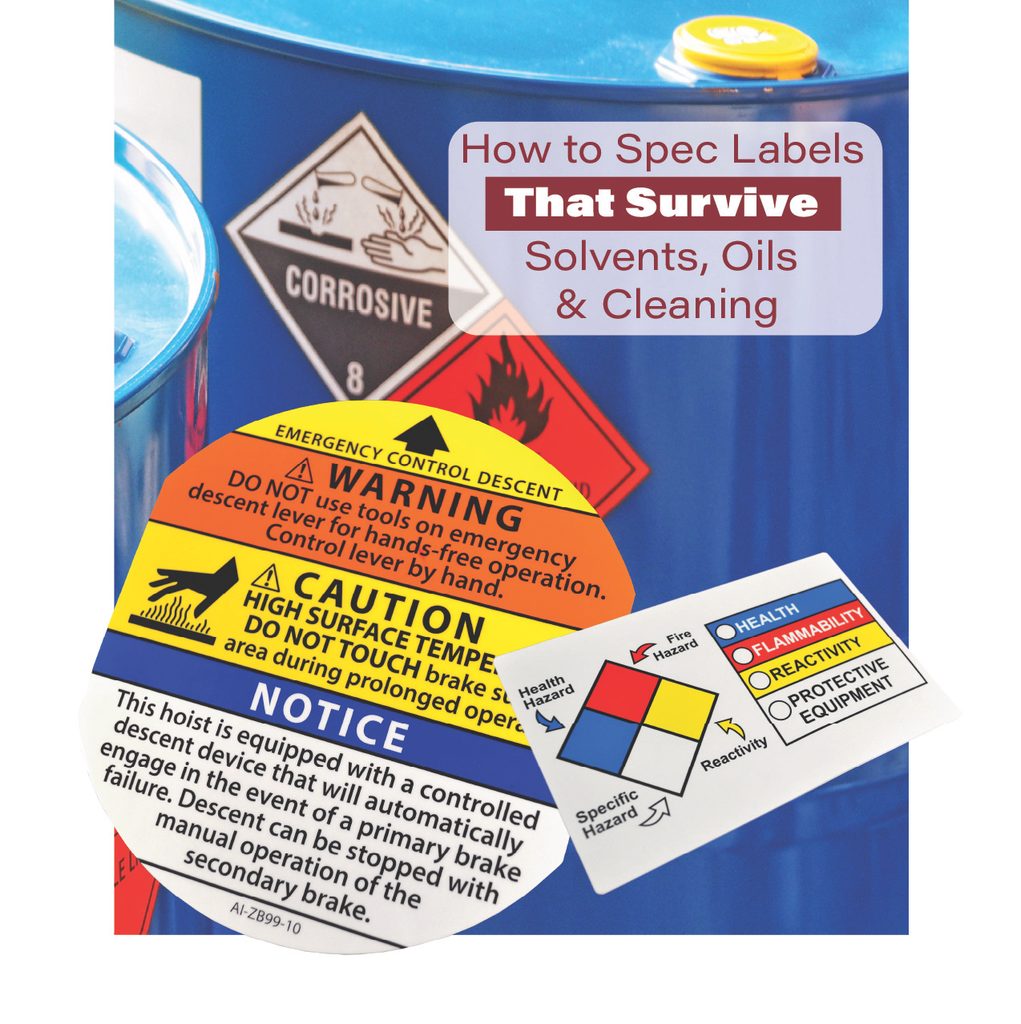
A chemical-resistant label is designed to remain legible and securely attached when exposed to specific chemicals during its intended service life. Achieving that performance requires matching the face stock, printing system, protective layers, and adhesive to the actual application.
Polyester is a common choice for durable industrial labels because it offers good mechanical strength and can provide resistance to chemicals, oils, and elevated temperatures. But the face stock is only one part of the construction. The printed image must withstand exposure, the adhesive must maintain its bond to the application surface, and any protective overlaminate must be compatible with the chemicals and conditions involved.
The best construction depends on the chemical involved, its concentration, the temperature, how long contact lasts, and whether exposure occurs through splashes, wiping, immersion, or repeated cleaning. Specifying the chemical exposure—not simply requesting a “chemical-resistant label”—is the first step toward a reliable result.
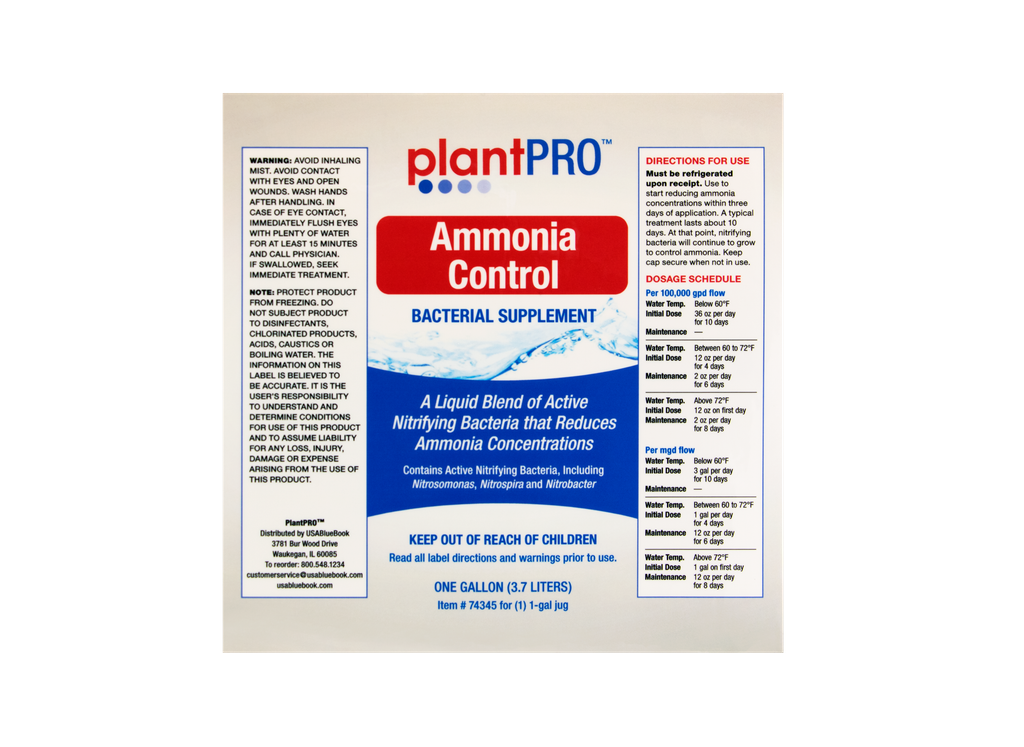
Chemical exposure can compromise a label in several different ways. Understanding which failure is most likely helps determine what the construction needs to withstand.
Solvents and cleaning agents can affect the ink, printed coating, or protective surface. Depending on the materials and exposure conditions, the result may be smearing, fading, loss of contrast, or damage to the printed image.
This matters when labels carry serial numbers, safety warnings, operating instructions, barcodes, or traceability information. A label that remains attached but becomes unreadable has still failed its purpose.
A compatible printing system and, where appropriate, a protective overlaminate can help preserve the printed image. The combination should be evaluated under the chemicals and exposure conditions expected in service.
The face stock is the material that carries the printed information. Paper, vinyl, polyester, and other films have different physical and chemical properties, so they should not be treated as interchangeable.
Polyester is often considered for durable industrial applications where chemical, oil, moisture, and temperature resistance are important. For example, technical information for a UPM Raflatac white polyester construction describes its use on durable products, drums, PET containers, and PET packages where resistance to water, oil, and chemicals is desirable.
The important distinction is that a material’s general suitability does not guarantee resistance to every chemical. Compatibility still needs to be established for the particular chemical and application.
A label can have a durable face stock and legible print yet still fail if the adhesive softens, loses adhesion, or allows the edges to lift.
Adhesive selection should account for the surface being labeled, its texture and surface energy, the application temperature, the service temperature, and the expected chemical exposure. The condition of the surface also matters: oil, dust, moisture, or other contamination can interfere with bonding.
Some industrial acrylic adhesives offer documented resistance to solvents, humidity, oils, mild acids, and alkalis. However, those properties belong to the specific adhesive and test conditions. They should not automatically be applied to every face stock, ink, or finished label construction.
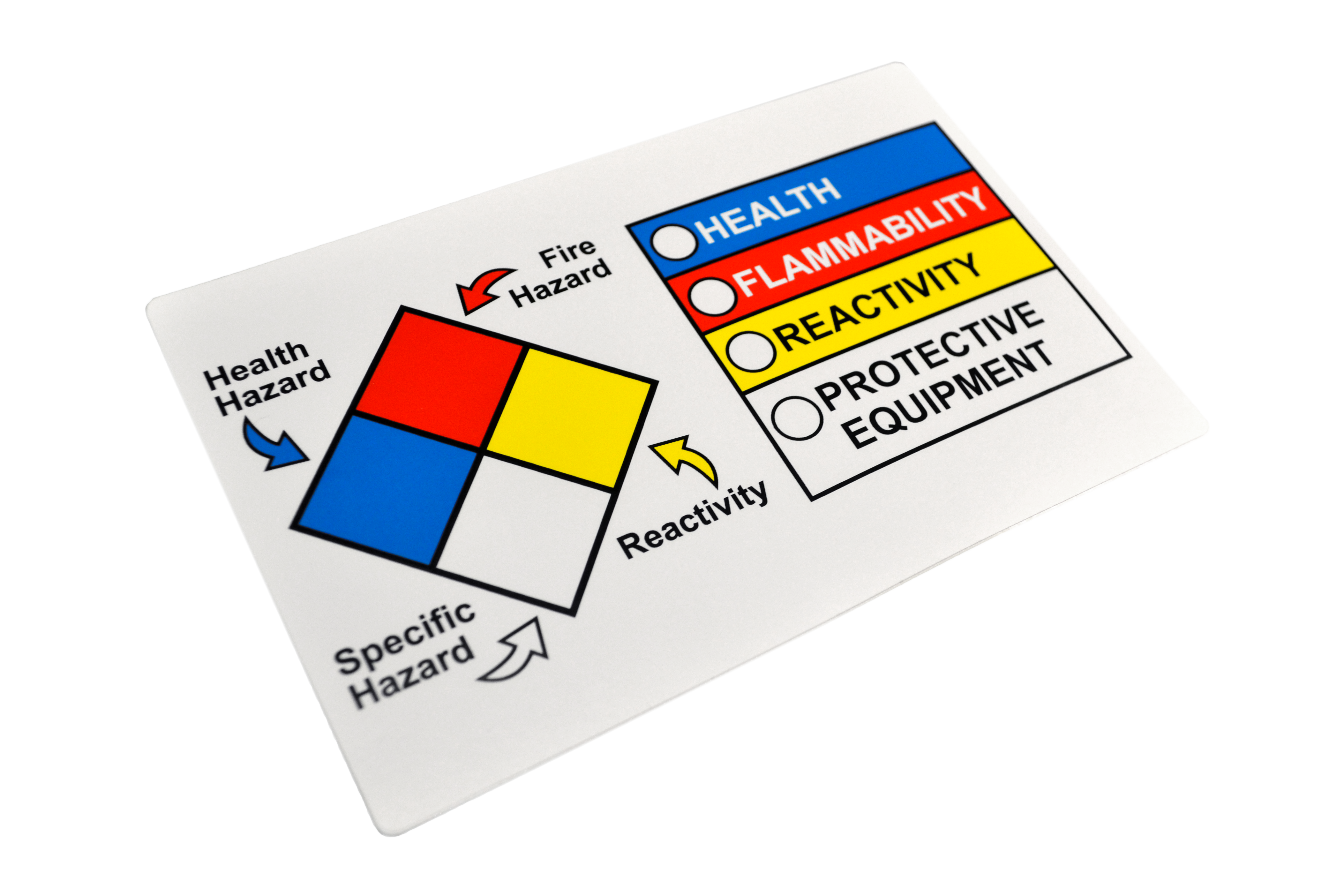
A durable chemical-resistant label is a system of components that must work together.
Polyester is a strong starting point for many durable industrial labeling applications. Depending on the grade and construction, it can offer useful resistance to chemicals, oils, moisture, and heat while maintaining dimensional stability.
Other materials may be appropriate for specific requirements, including applications that need flexibility, a particular appearance, or specialized printing. The correct choice depends on the exposure and the surface to which the label will be applied.
The question is not simply whether a material is polyester or vinyl. It is whether the particular grade has suitable performance for the actual conditions.
The printing process, ink or ribbon, and printable coating all affect image durability.
A material that accepts ink well during production is not necessarily resistant to the solvents encountered during use. Printing compatibility and chemical resistance are separate considerations, and both should be evaluated.
For thermal-transfer labels, for example, the face stock and ribbon need to work together. For digitally or screen-printed labels, the ink system and surface treatment must be compatible with the material. Testing the finished print is important because the result depends on the complete combination.
A protective overlaminate can provide a barrier over the printed image and may also improve resistance to abrasion and handling. It is particularly worth evaluating when labels will be wiped down, exposed to cleaning agents, or handled frequently.
The overlaminate must be compatible with the underlying print and suitable for the chemicals involved. It is not a universal solution: the laminate itself, its adhesive, and the edges of the finished label may respond differently to different exposures.
Technical data for 3M Polyester Overlaminating Film 7730FL, for example, reports no change under specified tests involving isopropyl alcohol, detergent, and engine oil at 250°F. The same document reports slight fogging after water exposure. These results illustrate why the individual test conditions—and the exact product—matter when choosing a protective layer.
Adhesive selection is just as important as face-stock selection. The adhesive needs to maintain contact with the substrate despite the expected exposure, temperature changes, and service conditions.
Some constructions use permanent acrylic adhesives designed for durable film labels and good chemical and temperature resistance. Other applications may require a different adhesive chemistry or a specialized construction.
Do not assume that an adhesive’s solvent resistance means the finished label will resist the same chemicals. The face stock, ink, overlaminate, adhesive, and labeled surface all contribute to performance.
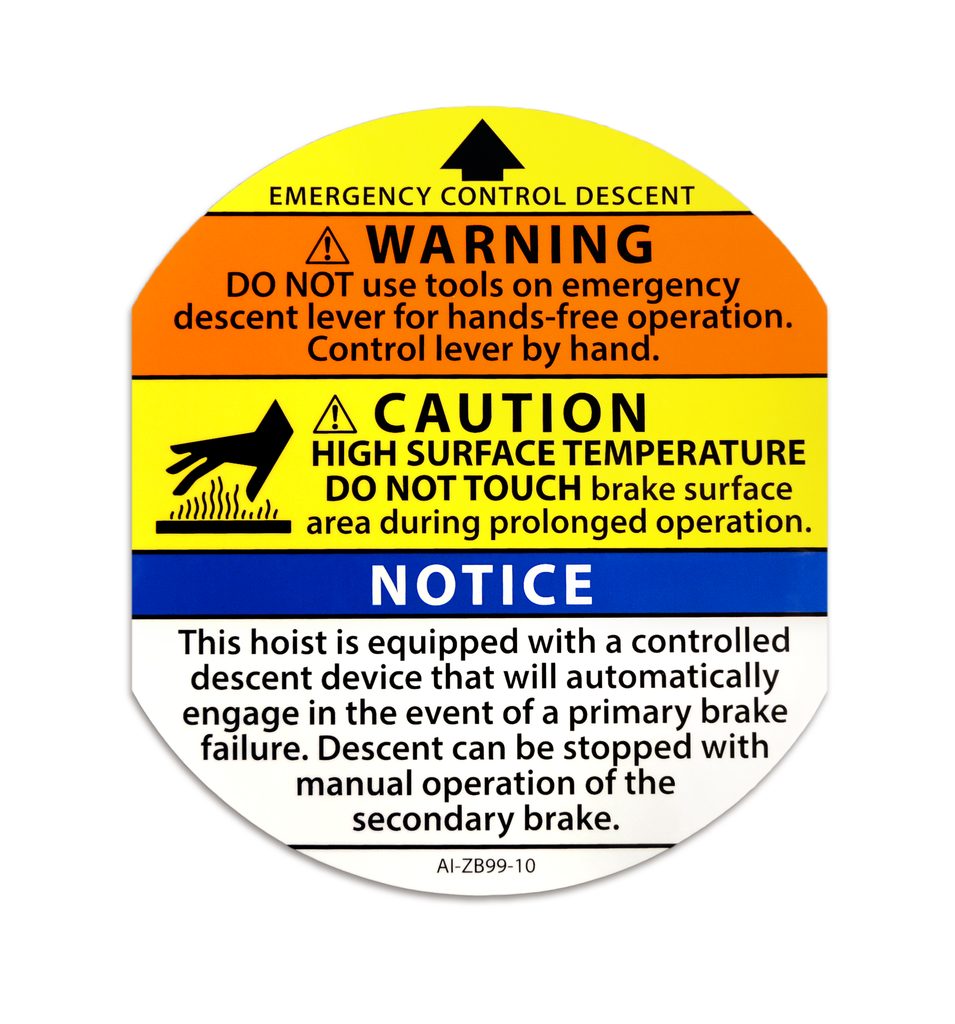
Manufacturer test data can help narrow the material choices, but the details of the test matter.
For example, technical data in the available material documentation for 3M Thermal Transfer Polyester Label Material 7871 includes tests involving:
The data evaluates characteristics such as appearance, edge penetration, and adhesion to stainless steel after chemical exposure. These are useful indicators because a label may look unchanged while its adhesive performance has changed—or may remain attached while the printed information has deteriorated.
The results should be interpreted as product-specific test evidence, not as a guarantee that all polyester labels will withstand all of these chemicals under all conditions. Exposure duration, temperature, concentration, application surface, and the full label construction can change the outcome.
For demanding applications, the most useful next step is to identify the actual chemical and agree on the performance criteria the finished label must meet.
Chemical-resistant constructions may be worth evaluating in applications such as:
These are potential application categories, not a claim that one construction is suitable for every environment in each category. The chemical exposure, surface, temperature, and expected service life should guide the specification.
When requesting a label for a chemical-exposed environment, gather the following details before selecting a material.
1. Identify every chemical. Provide the product name or chemical identity where possible. “Solvent,” “oil,” and “cleaner” are too broad to establish compatibility.
2. Describe the exposure. Will the label experience an occasional splash, repeated wiping, continuous contact, or full immersion? Include how often exposure occurs and how long the chemical remains on the label.
3. Include temperature and concentration. A chemical may affect a construction differently at elevated temperatures or at different concentrations. Include the expected operating temperature and any hot cleaning or washdown conditions.
4. Describe the application surface. Identify the substrate—such as painted metal, stainless steel, plastic, or a textured surface—and whether it is curved, oily, or otherwise difficult to bond to.
5. Explain the printing requirements. Specify whether the label requires variable data, barcodes, small text, color graphics, or other information that must remain readable.
6. Establish the acceptance criteria. Decide what counts as success. For example, the label may need to remain attached, retain readable print, show no unacceptable discoloration, or preserve barcode readability after a defined exposure.
7. Test the finished construction. When failure would affect safety, compliance, identification, or equipment operation, evaluate the complete label under representative conditions before committing to production.
Chemical-resistant labeling is a material-selection problem, not simply a choice of label shape or print method. A successful specification considers the face stock, printing system, protective layer, adhesive, application surface, and actual chemical exposure.
Label-Aid Systems can work with customers to evaluate these requirements and identify a suitable label construction. Where the application warrants it, testing can help determine whether the proposed combination meets the required performance criteria.
With a clear understanding of the chemicals involved, how frequently they contact the label, and the conditions the label must withstand, the material-selection process becomes more precise—and the risk of choosing an unsuitable construction is reduced.
Chemical resistance depends on the complete construction: the face stock, printing system, any protective overlaminate, and the adhesive. Each component must be compatible with the expected chemical exposure and service conditions.
It depends on the ink or ribbon, printable surface, protective layers, and solvent. A compatible printing system and suitable overlaminate can help protect the image, but the finished construction should be tested against the actual solvent and exposure conditions.
There is no universal list that applies to every label. Some manufacturer data sheets include testing with chemicals such as isopropyl alcohol, detergents, oils, acetone, toluene, gasoline, and hydraulic fluids. Results vary by product and test conditions, so the specific chemicals and exposure conditions should be reviewed before selecting a construction.
Some durable polyester constructions and industrial adhesives offer elevated-temperature performance. However, chemical resistance and temperature resistance are separate properties. The temperature rating for the complete label must be appropriate for the application, including any period when chemical exposure and heat occur together.
No. An overlaminate may be useful when print protection or additional surface durability is needed, but it is not required for every application. Its compatibility with the print, face stock, adhesive, and chemicals should be evaluated as part of the finished construction.
Testing the finished construction under representative conditions is a useful way to evaluate performance. The test should reflect the chemical, concentration, temperature, exposure method, duration, substrate, and acceptance criteria relevant to the application.
Tell Label-Aid which chemicals your labels will contact, how often exposure occurs, the application surface, and the temperature range. We can help evaluate the requirements, identify an appropriate construction, and discuss testing before you move into production.